

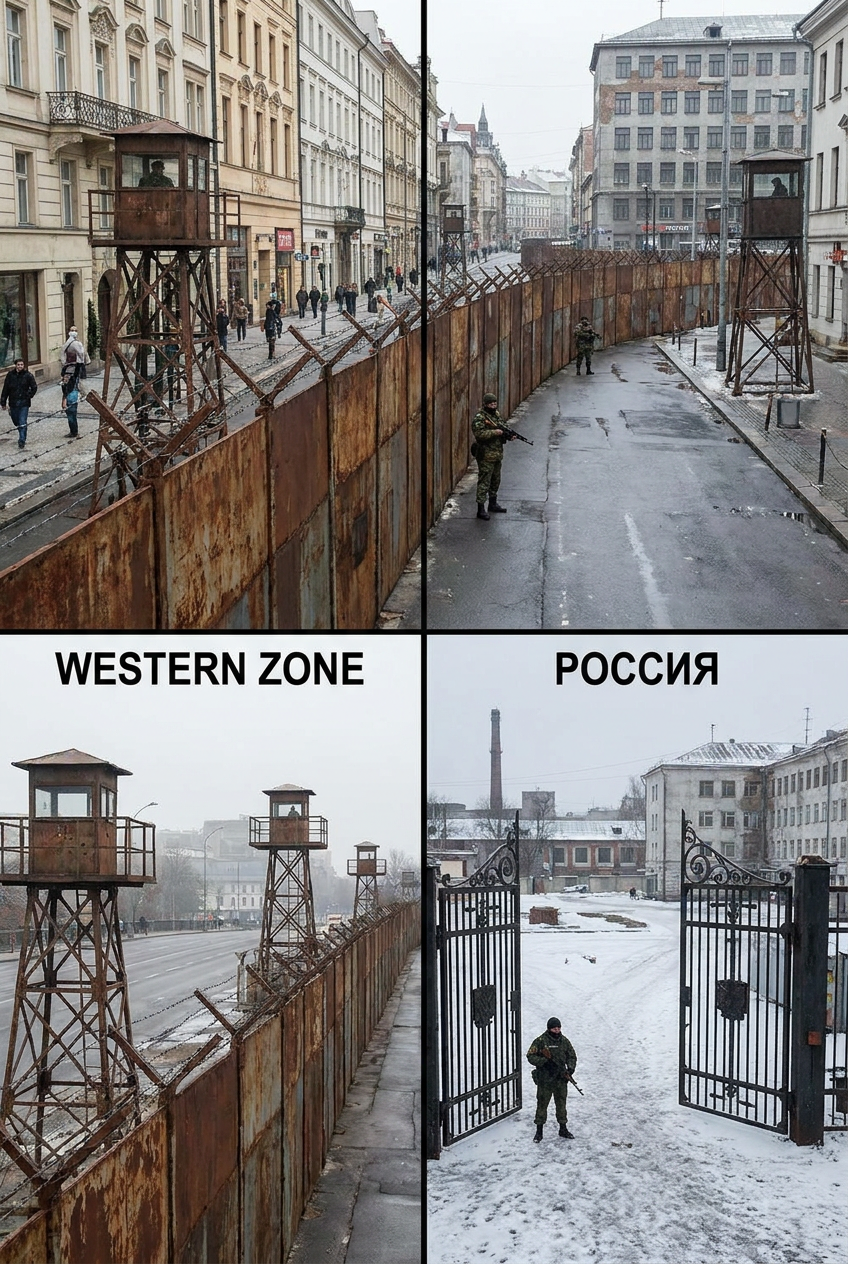
This is what the old Iron Curtain looked like

“We Are Living Behind a Double Iron Curtain”: A Soviet Childhood, Propaganda, and the American Dream
A candid conversation about growing up in the USSR, the rewriting of history, and why the West might be more isolated today than Russia was during the Cold War.
During the tour, I spoke with Gherman, born during Soviet times. After the Soviet Union ended, he lived in Italy for 20 years, and England for 2 before returning to Crimea, Russia.
Eric (Interviewer): So, German is the guide for this tour. Who remembers Caribbean conflict. Right, born right after the, we call it right after the Cuban Missile Crisis.
Gherman (Guest): Cuban, yeah, exactly, Caribbean, Cubans.
Eric: And we’re heading into another Cuban Missile Crisis.
Gherman: Absolutely, in a couple of days.
Eric: Right, unbelievable. So, but what was it like for you as a child living in the Soviet Union at that time?
Positive Memories of the Soviet Era
Gherman: But my recordings are positive now, right? At my age I remember all these positive things actually having a lot of negative points, moments that were brought by the new formation, okay? By Perestroika and so on and so on. So my memories of my recordings are very positive actually.
“No individualism, you know, friendship… so the work guaranteed, the healthcare guaranteed all those things so education free, you know.”
But the quite obvious things actually right so the atmosphere was different, okay. And also the relations between the relation between people.
Eric: Okay, we didn’t see the client, you know?
Gherman: We saw or, you know, we considered people as friends or potential friends, but not the client to milk, you know?
Eric: Right.
The Shift After the Soviet Union Collapsed
Gherman: The main difference maybe right now it’s changed totally changed and I agree about that that’s what I don’t like about today right. But so there are also positive things today definitely right so we can travel. So I traveled a lot a lot I lived in Italy for 20 years I lived in London for two years you know.
Eric: I don’t know if you’re aware of this but I did some research myself and I learned that after the Soviet Union ended the education curriculum changed. But what I found out was it was changed to be more objective but who wrote the curriculum? It was written by the U.S. State Department.
Gherman: Exactly.
Eric: Far from the objective.
Gherman: Far from objective. Um, so the hope was this okay to be to have more objective view on the world you know and the possibility to study wherever in London you know in Cambridge in Oxford in Harvard and so on and on to travel to see to know to absorb you know so and interesting it happened actually right.
The “Double Iron Curtain” Theory
Gherman: But nowadays we can’t talk about objectivity or whatever right so it’s sort of politically influenced right it’s so unobjective actually very unobjective actually. I have this feeling extremely I would say you know we have a risk of they were, actually, you know, because of that, you know?
“I have a feeling that we’re living behind a double iron curtain. The people in the West are behind at least as much of an iron curtain as the people in Russia.”
Eric: Exactly, exactly.
Gherman: But in terms of information or propaganda, let’s say, yeah? These days, I think, the Western propaganda and so Western filters of information are much, much harder and, you know, stronger than Iron Curtain.
Eric: Mm-hmm.
Gherman: So right interesting. Iron Curtain was quite actually firm, right? And protected us let’s say protected us. But now we have a situation which is opposite, right? And even more than we expected, one more than we could imagine actually right not expected could imagine even could not even imagine.
Eric: Exactly could not even imagine not even in the worst dream nightmare.
Gherman: Absolutely yes I agree.
Closing Thought: George Carlin on the American Dream
Eric: I’ll just finish here. There was a very popular American comedian named George Carlin, and he did a little segment and he said, “Why is it that our education system is no good, our old people are unhealthy, everything is not working? And he says, it’s the American dream. You have to be asleep to believe it.”
Gherman: Exactly.
Eric: Very well.
End of Transcript